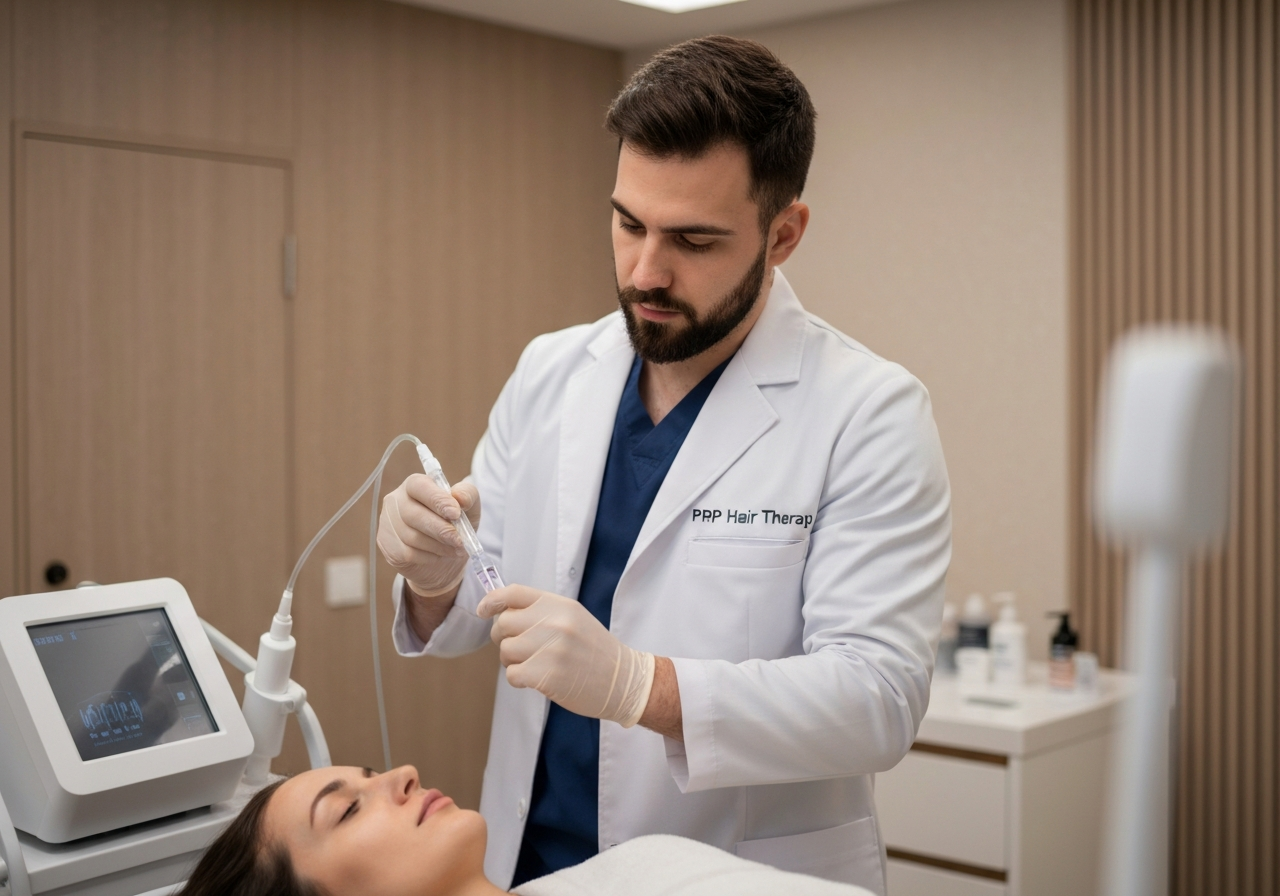
If you are researching hair loss treatments in Atlanta, you have almost certainly come across Platelet-Rich Plasma (PRP) therapy. It has been featured in major medical journals, endorsed by dermatologists worldwide, and embraced by clinics from Buckhead to Beverly Hills. But a common and entirely fair question remains: is PRP hair treatment actually worth it? The answer depends on your stage of hair loss, your goals, your budget, and whether you are working with a qualified medical provider who can diagnose the root cause of your thinning. In this comprehensive guide, we will break down exactly what PRP is, how it compares to other treatments, what it costs in the Atlanta market, who makes an ideal candidate, and what kind of results you can realistically expect.
What Is PRP Hair Therapy?
Platelet-Rich Plasma therapy is a non-surgical, regenerative medical treatment that uses your own blood to stimulate hair follicles. The process is elegantly simple in concept but requires precise clinical execution. A small amount of blood is drawn from your arm, placed into a specialized centrifuge, and spun at high speeds to separate the platelet-rich plasma from red and white blood cells. This concentrated plasma is loaded with growth factors — naturally occurring proteins that play a critical role in tissue repair, cell regeneration, and wound healing. When strategically injected into areas of the scalp experiencing thinning, these growth factors act like fertilizer for dormant or struggling hair follicles.
The science behind PRP is well established. Platelets contain dozens of growth factors, including Platelet-Derived Growth Factor (PDGF), Vascular Endothelial Growth Factor (VEGF), and Transforming Growth Factor (TGF). These proteins increase blood supply to the follicle, extend the anagen (growth) phase of the hair cycle, and encourage the proliferation of cells that produce the hair shaft itself. In short, PRP does not transplant new hair — it revitalizes the hair you already have, making it thicker, stronger, and more resilient.
PRP vs. Minoxidil (Rogaine)
Minoxidil, commonly known by the brand name Rogaine, is an FDA-approved topical treatment that has been a staple of hair loss management for decades. It works by increasing blood flow to the scalp and is available over the counter in 2% and 5% concentrations. For many patients, it is a reasonable first-line option, particularly for those with very early-stage thinning. However, minoxidil has notable limitations. It requires daily application indefinitely — stop using it, and any regrown hair will fall out within months. Some patients experience scalp irritation, unwanted facial hair growth, or initial shedding during the first few weeks. And critically, minoxidil primarily slows loss rather than producing significant regrowth.
PRP, by contrast, delivers concentrated growth factors directly to the follicle in a way that topical minoxidil simply cannot replicate. Clinical studies have shown that PRP produces measurable improvements in hair density and shaft thickness that often exceed what minoxidil achieves alone. Many providers, including our practice, recommend combining the two — PRP injections as the primary driver of regrowth, with minoxidil as a daily maintenance support. The synergy can be powerful, but PRP is the more potent and clinically directed intervention.
PRP vs. Hair Transplants (NeoGraft FUE)
A hair transplant, such as the NeoGraft FUE procedure we offer, is the gold standard for patients with significant, visible hair loss — particularly those with established recession at the temples, thinning crowns, or areas where follicles have been dormant for years. A transplant physically relocates healthy, genetically resistant follicles from the donor area (typically the back of the scalp) to the thinning zones. It is a permanent, surgical solution that produces dramatic, lasting results.
PRP is not a substitute for a transplant when a transplant is what you need. If your follicles have been dormant for too long, no amount of growth factor will revive them. However, PRP plays two critical roles relative to transplantation. First, it is an excellent option for patients who are not yet candidates for surgery — those in the early stages of thinning where a transplant would be premature or overly aggressive. Second, PRP is frequently used as a complementary therapy after a NeoGraft procedure to accelerate healing, improve graft survival rates, and boost overall density. The combination of surgical relocation and biological stimulation often yields the most comprehensive results.
PRP vs. Prescription Medications
Finasteride (Propecia) and dutasteride are oral prescription medications that work by inhibiting the enzyme that converts testosterone to DHT — the hormone primarily responsible for male pattern hair loss. These medications can be highly effective at slowing or halting progression, and they are often prescribed alongside other treatments. However, they come with potential side effects that give some patients pause, including decreased libido, mood changes, and in rare cases, persistent sexual side effects even after discontinuation. They also require a lifelong commitment; stopping the medication typically results in resumed hair loss.
PRP offers a fundamentally different mechanism. Rather than systemically altering your hormone profile, it works locally at the follicle level using your own biological material. There is no risk of hormonal side effects, no daily pill to remember, and no systemic exposure. For patients who are uncomfortable with the idea of taking a DHT inhibitor long-term, PRP provides a meaningful alternative or complementary approach that addresses the scalp environment directly.
Who Is the Ideal Candidate for PRP?
PRP is not a one-size-fits-all solution, and managing expectations is essential. The patients who see the best results typically share these characteristics:
- Early to moderate hair loss: Follicles must still be alive for PRP to stimulate them. Patients in Norwood stages I–IV (men) or Ludwig grades I–II (women) tend to respond best.
- Recent onset of thinning: Hair loss within the last 1–3 years generally responds more robustly than decades-old loss.
- Diffuse thinning rather than complete baldness: Areas with peach fuzz or fine hairs still have active follicles that can be revitalized.
- Female pattern hair loss: Women, who are often not candidates for transplant due to diffuse thinning patterns, frequently respond very well to PRP.
- Post-transplant patients: PRP accelerates healing and enhances graft survival after NeoGraft FUE.
Patients with complete baldness in the treatment area, active scalp infections, or certain blood disorders may not be suitable candidates. This is why a thorough medical evaluation with a qualified physician — not a sales consultation — is the essential first step.
What Does PRP Cost in Atlanta?
Pricing for PRP hair therapy varies based on the provider's expertise, the concentration system used, and the number of areas treated. In the Atlanta market, a single PRP session typically ranges from $500 to $1,500. A full initial protocol usually involves three sessions spaced approximately one month apart, followed by maintenance treatments every 6–12 months. This places a complete first-year protocol in the range of $2,000–$5,000 depending on the specifics of your case.
Is that worth it? Consider the alternative costs. A NeoGraft FUE transplant — which is permanent but surgical — starts at $4.50 per graft with a minimum of 1,000 grafts, placing the starting price around $4,500 and often higher for extensive cases. Minoxidil and finasteride are cheaper per month but require a lifetime of continuous spending with cumulative costs that can exceed the price of PRP over several years. PRP occupies a middle ground: a meaningful investment that produces measurable results without surgery, and without the lifelong commitment of daily medications.
What Results Can You Realistically Expect?
Realistic expectations are the foundation of a successful PRP experience. Most patients begin to notice changes — reduced shedding, improved hair texture, and early signs of thickening — within 2–3 months of their first session. Maximum results typically appear 6–9 months after completing the initial protocol, as the hair growth cycle is slow. Clinical photography at our Atlanta office documents measurable increases in hair density and shaft diameter in the majority of responsive patients.
It is important to understand that PRP is not a cure. Hair loss is a progressive, often genetic condition. PRP can slow that progression, improve the quality of existing hair, and in many cases produce visible regrowth — but maintenance sessions are required to sustain results. Think of it like fitness: the initial program gets you in shape, and ongoing maintenance keeps you there. Patients who commit to the full protocol and follow maintenance guidelines consistently see the best long-term outcomes.
Why Provider Expertise Matters
Not all PRP treatments are created equal. The concentration of platelets, the injection technique, the depth and placement of injections, and the overall treatment protocol all influence outcomes. A double board-certified physician with decades of experience in regenerative medicine — like Dr. Monte Slater — brings a level of diagnostic precision and clinical skill that directly impacts your results. We have seen patients who received PRP elsewhere with minimal improvement achieve significantly better outcomes after a properly executed protocol at our practice.
The bottom line: PRP hair treatment is worth it for the right candidate, when performed by the right provider, with the right expectations. If you are in the early to moderate stages of hair loss and want a non-surgical, natural approach backed by clinical evidence, PRP is one of the most compelling options available in Atlanta today. The best way to determine if it is right for you is a personalized consultation where we evaluate your scalp, discuss your history, and build a treatment plan tailored to your specific needs.